
The Architecture of Moral Authority: Olara Otunnu’s Bid to Anchor a Fractured United Nations
Abstract Welcome to The Undercurrent. In this issue, we talk about what happens when the world’s premier multilateral institution faces unprecedented structural paralysis, a severe liquidity crisis, and escalating regional conflicts and why a veteran African statesman argues that the key to reviving global governance lies in reclaiming the UN’s original currency: moral authority.
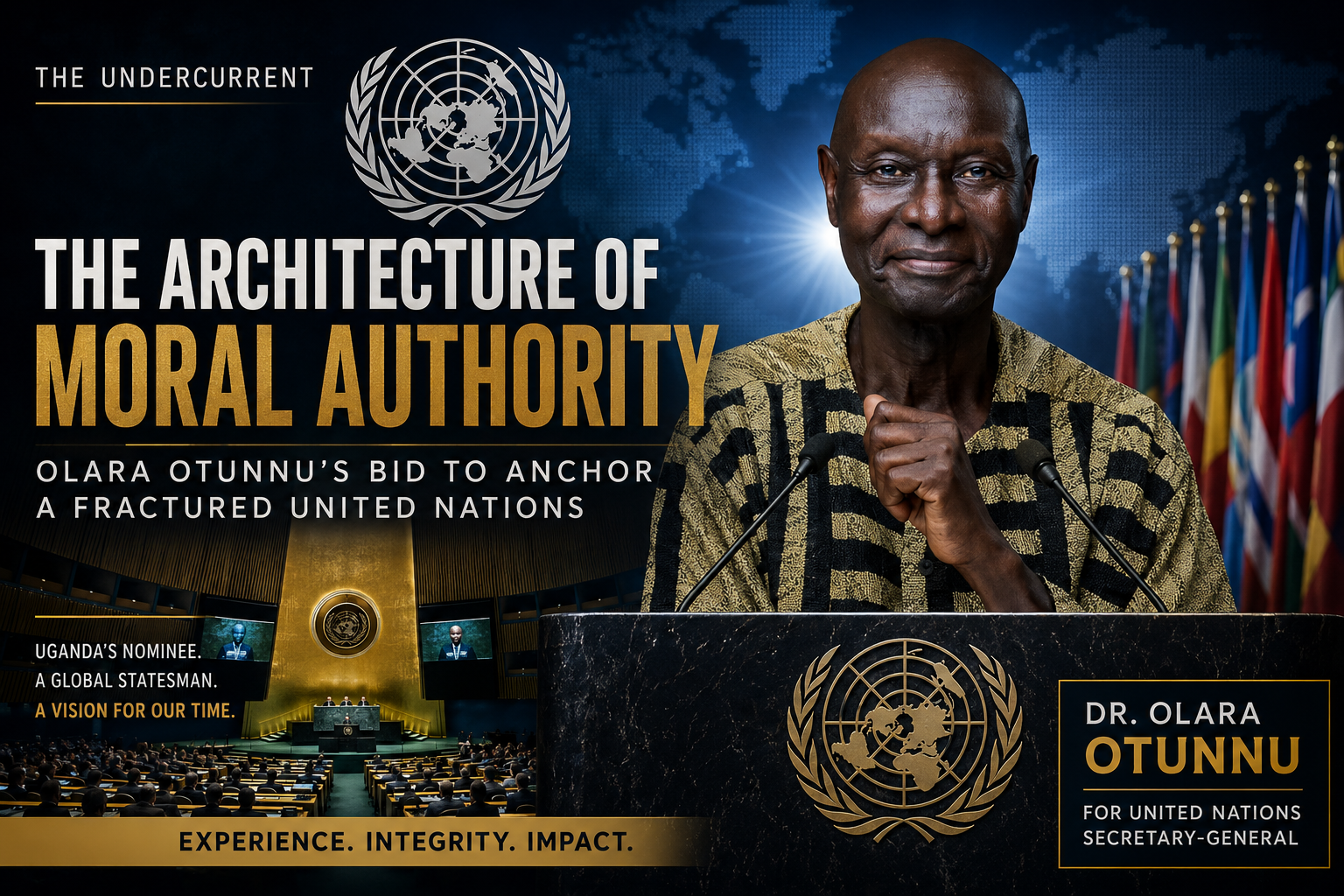
Inside the United Nations General Assembly Hall in New York, on the 19th of August, 2026, Ambassador Dr. Olara Otunnu stepped into the interactive dialogue stage as Uganda’s official nominee for Secretary-General. Competing alongside a crowded field of international contenders to succeed António Guterres at the end of 2026.
Otunnu’s candidacy represents a decisive moment for global diplomacy.
The Power of Mandate vs Moral Weight.
The chief executive of the United Nations commands no standing army, enforces no tax regime, and holds no sovereign territory. During his three-hour session with UN member states, Otunnu underscored a fundamental reality: the Secretary-General’s most potent instrument is not coercive power, but the strategic deployment of moral authority anchored in the UN Charter. When power blocs fragment and vetoes freeze the Security Council, moral authority is often the only force capable of compelling warring parties to the negotiating table.
The Mechanic of Multilateralism. Otunnu’s platform is built on proven institutional engineering rather than abstract rhetoric:
The Otunnu Formula: In 1981, while serving as UN Security Council President in his early thirties, Otunnu invented the secret straw-balloting procedure used to break election deadlocks. Known as the “Otunnu Formula,” this procedure remains the standard mechanism for selecting UN Secretaries-General to this day.
Resolution 1612 & Human Rights: As the first Special Representative for Children and Armed Conflict (1998–2005), he authored the compliance framework under UN Security Council Resolution 1612. This legally binding mechanism created a concrete monitoring system to hold governments and insurgent groups accountable for violations against children in war zones.
Navigating the UN80 Reform Agenda. As the United Nations approaches its 80th anniversary amid deep fiscal strain, Otunnu’s agenda addresses three critical frontiers:
-
Institutional Renewal: Guiding the UN80 initiative by eliminating redundant bureaucratic mandates, aligning operational budgets with core humanitarian priorities, and resolving the Secretariat’s liquidity shortfall.
-
Active Conflict Resolution: Prioritising immediate diplomatic mediation in global hotspots including the conflicts in Ukraine, Gaza, and Sudan with a focus on protecting war-affected populations.
-
Governing Emerging Frontiers: Establishing international governance frameworks to manage the rapid proliferation of Artificial Intelligence (AI), ensuring technological advancement benefits global development without deepening digital inequalities.
The Undercurrent Takeaway In an era dominated by unilateral moves and escalating geopolitical tensions, the selection of the next UN Chief will dictate whether international law remains enforceable or fades into symbolic dialogue.
So the question remains: Can an institution driven by raw power dynamics truly be steered by moral authority, or must the fundamental architecture of global governance change first?
Responses 0
Reading is open to everyone. Sign in by email to respond.
Loading responses…