
The Era of Loop Engineering: Why We Stopped Prompting and Started Building Cycles
Abstract Welcome back to The Undercurrent. In this piece, we explore the rapid evolution of AI development workflows. As prompting gives way to systemic automation, software engineering is undergoing its biggest structural shift in years. Here is your essential read on the era of loop engineering.
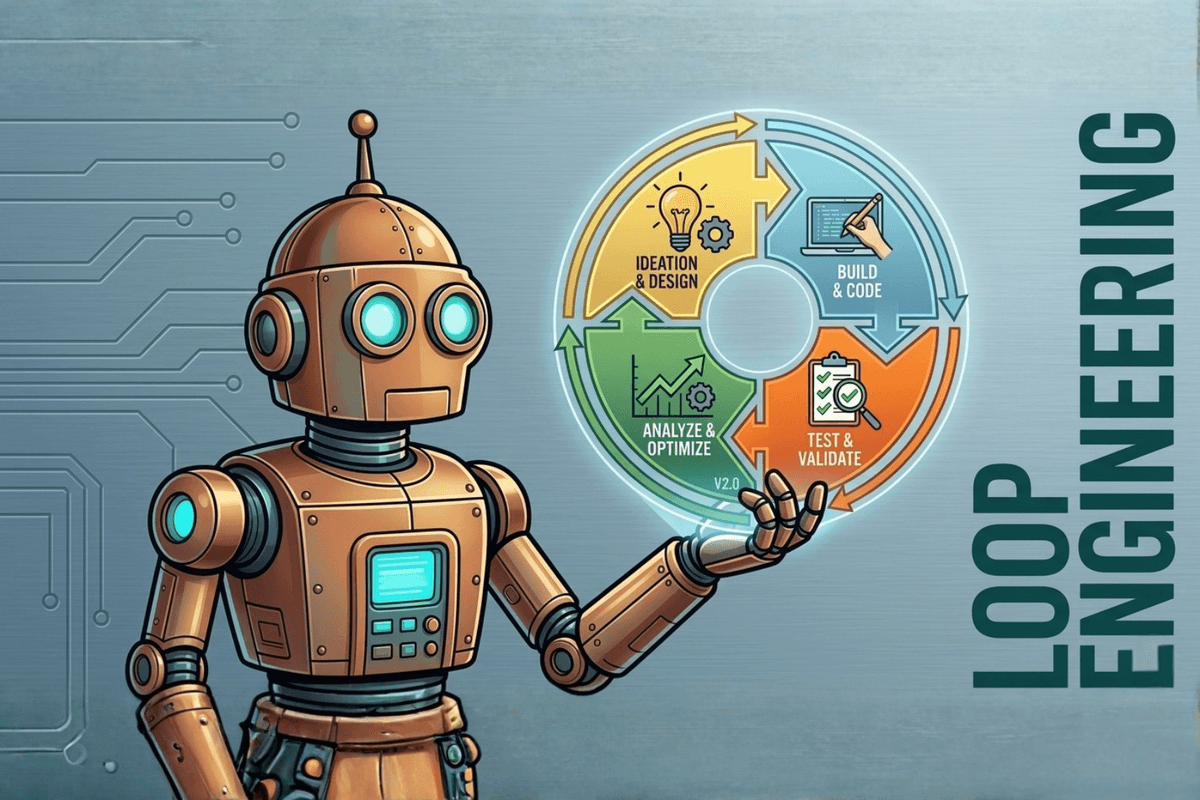
For the past few years, interacting with AI coding assistants felt like an intense game of chess. You typed a prompt, inspected the output, caught a bug, typed the next instruction, and repeated the process turn by turn. You were in the driver’s seat for every single micro-decision.
That era is rapidly coming to an end.
A seismic shift has taken over software engineering termed as LOOP ENGINEERING. Popularized by industry leaders and framework builders, the mantra has quickly become: Stop prompting your coding agent, and start designing the loop that prompts it for you.
The Evolution of the AI Engineering Stack To understand why loop engineering represents such a massive leap forward, it helps to look at how developer workflows have evolved in a remarkably short span of time:
Prompt Engineering (2022–2024): The focus was entirely on wording. Developers learned to craft the optimal single instruction, assign roles, and ask models to think step-by-step.
Context Engineering (2025): As applications scaled, the focus shifted to information architecture managing what data enters the model’s context window and discarding excess noise to prevent degradation.
Harness Engineering (Early 2026): Developers began building secure, structured environments around agents scaffolding tools, terminal access, and file systems so agents could operate safely in production.
Loop Engineering (Mid-2026 onward): This is the current frontier. Rather than focusing on a single execution or environment, loop engineering designs the autonomous feedback cycle that keeps an agent working toward a complex goal for hours without human intervention.
What is Loop Engineering? At its core, loop engineering is the practice of designing the system that prompts, checks, remembers, and re-runs an AI agent.
Instead of treating an AI tool as a one-shot code generator, a loop treats software development as an iterative, self-correcting system. A well-engineered loop follows a continuous cycle:
Intent: The developer or automation system defines a clear, testable goal (e.g., “Fix this bug and ensure all CI tests pass”).
Action: The agent executes a step, writes code, queries a database, or modifies files inside an isolated sandbox like a Git worktree.
Observation: The system captures real-world signals compiler errors, linter output, test failures, or runtime exceptions.
Adjustment: Using the feedback, the agent updates its internal plan and tries again, repeating the loop until a hard success condition is met or an escalation threshold is tripped.
The Core Pillars of a Robust Loop Building a loop that can run unattended for an hour requires more than just connecting an LLM to a terminal. Successful loop engineers focus heavily on a few critical structural boundaries:
Strict Termination Criteria: An open-ended loop can easily spiral into infinite token-burning loops if it keeps trying and failing the same test. Robust loops feature strict no-progress detection and circuit breakers.
Context Compression: Over a long-running task, context windows fill up with redundant error logs and discarded code variants. Effective loops use summarization and external memory logs (like file systems or git histories) to keep the agent sharp.
Real-World Verifiers: The backbone of a great loop is an objective validation signal such as a passing test suite or type checker rather than the agent’s own subjective “I think I’m done” assessment.
A New Role for Developers The rise of loop engineering doesn’t mean developers are out of a job; rather, it elevates our position in the stack.
We are no longer micromanaging syntax or writing repetitive prompts. Instead, we are acting as system architects of autonomous workflows designing the boundaries, guardrails, and feedback loops that allow AI agents to solve multi-step problems reliably.
The future belongs to those who master the loop.
Responses 0
Reading is open to everyone. Sign in by email to respond.
Loading responses…