
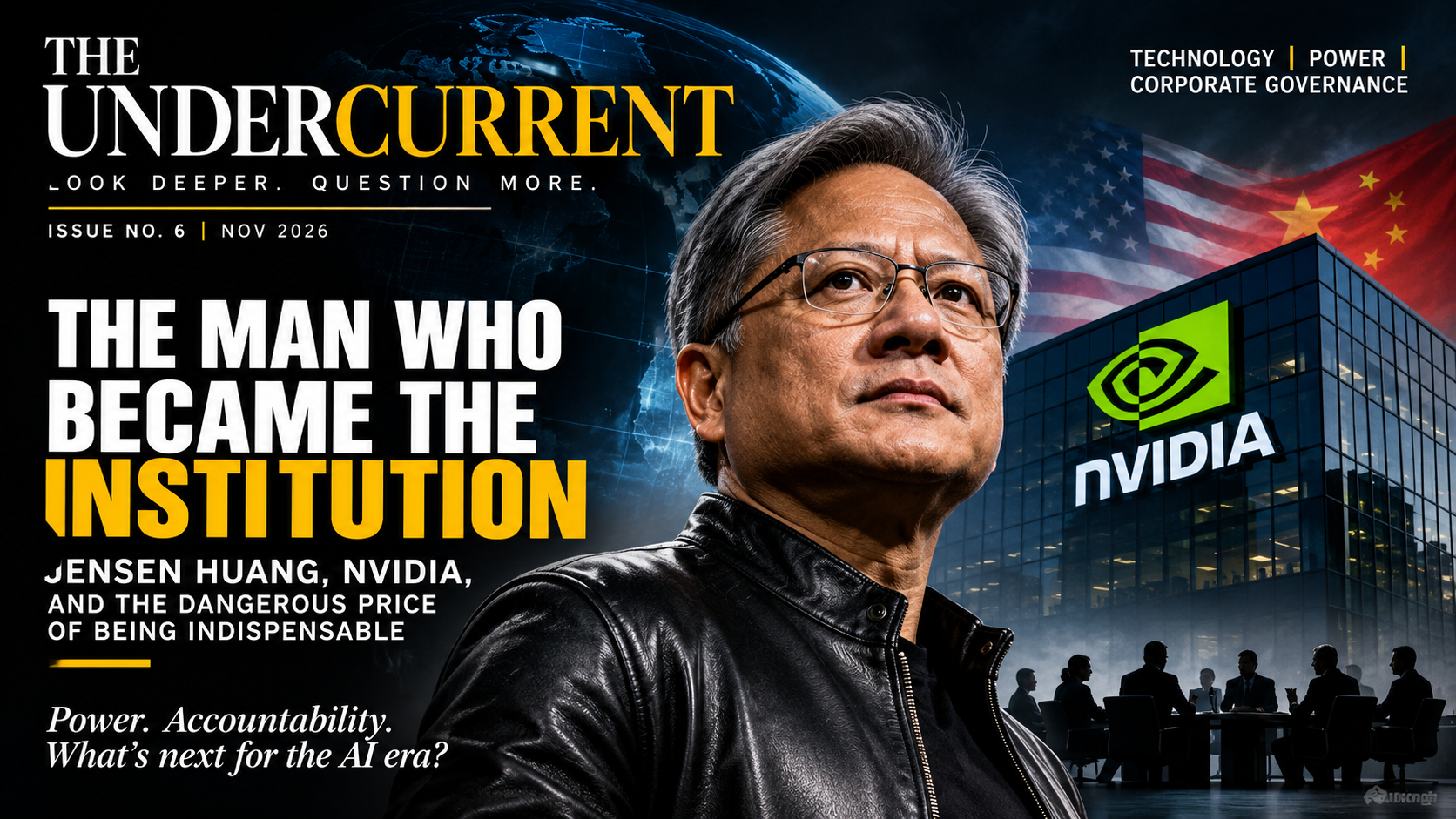
The Man Who Became the Institution: Jensen Huang, NVIDIA, and the Dangerous Price of Being Indispensable
Abstract Welcome back to The Undercurrent. In this issue, we examine the extraordinary rise and sudden departure of Jensen Huang, the man who helped transform NVIDIA from a graphics-processing company into one of the most powerful institutions in the artificial intelligence revolution. But this is not simply another story about a billionaire, a personal scandal or a corporate resignation. It is a story about what happens when the person responsible for building an institution becomes so important that the institution itself struggles to hold him accountable. In November 2026, the technology world was confronted with an unexpected development. Jensen Huang, NVIDIA's co-founder and long-serving chief executive, resigned from the company he had led for more than three decades. His departure followed revelations about an extramarital relationship, questions about his candour with senior company leadership, and allegations surrounding a businesswoman suspected by US authorities of having connections to Chinese intelligence. For a man who had become almost inseparable from the identity of NVIDIA, the departure was extraordinary. Yet, beneath the headlines was a much bigger question. How does a company built around the vision of one individual protect itself when that individual's decisions threaten the trust on which the institution depends? To understand why this matters, we must first understand the empire Huang built, the controversy that brought it under scrutiny, and the uncomfortable relationship between exceptional success and accountability. Because sometimes, the greatest threat to an institution does not come from its competitors. Sometimes, it comes from the person sitting at the top.
- Before the Fall, There Was an Empire
Long before NVIDIA became a household name in the artificial intelligence industry, Jensen Huang was making a bet on the future of computing.
In 1993, Huang co-founded NVIDIA alongside Chris Malachowsky and Curtis Priem. Their initial ambition was to develop graphics-processing technology capable of transforming how computers handled visual information.
At the time, the market was largely concerned with computer graphics, gaming and increasingly powerful visual experiences.
Artificial intelligence was not yet the commercial phenomenon it is today.
But Huang understood something that would eventually redefine the company’s future: computing would require more than increasingly powerful traditional processors.
Graphics processing units, or GPUs, were particularly effective at performing large numbers of calculations simultaneously. While originally developed for graphics, their architecture made them increasingly useful for scientific computing and complex mathematical workloads.
In 2006, NVIDIA introduced CUDA, a software platform that allowed developers to use its GPUs for general-purpose computing.
It was a decision that would become one of the most important strategic investments in the company’s history.
Researchers could now use NVIDIA hardware for workloads extending far beyond gaming. As machine learning developed, GPUs became increasingly valuable for training sophisticated artificial intelligence systems.
Then came the generative AI explosion.
The world suddenly needed enormous computing capacity to train and operate increasingly sophisticated AI models.
NVIDIA already had much of the infrastructure, software ecosystem and engineering expertise required to serve that demand.
The company was no longer simply selling graphics cards.
It was selling the computing foundation on which much of the AI revolution was being constructed.
Huang had spent decades positioning NVIDIA for a future that many businesses had not yet recognised.
By 2026, the company had become a central player in global technology, with its processors powering data centres, scientific research, advanced AI systems and the ambitions of some of the world’s largest corporations.
Its influence extended into the strategic interests of governments.
And Huang had become the public face of that transformation.
He was not just running a technology company. He was helping define the infrastructure of an emerging technological era.
That is precisely why his eventual departure would matter so much.
But the first signs of trouble had appeared long before November.
- The Relationship That Changed the Conversation
The controversy centred partly on Alice Huang, a Chinese businesswoman and former executive associated with Megaspeed International, a Singapore-based data-centre company that had business connections with NVIDIA.
Their relationship attracted particular scrutiny because of the geopolitical environment surrounding advanced semiconductor technology.
To understand the seriousness of the allegations, one must appreciate that NVIDIA’s processors are no longer ordinary commercial products.
Advanced AI chips are strategically important.
They can support scientific research, military applications, intelligence operations, industrial development and the creation of increasingly sophisticated artificial intelligence systems.
For this reason, the United States has imposed restrictions on the export of certain advanced semiconductor technologies to China.
Washington considers maintaining an advantage in advanced computing an important national-security priority.
China, meanwhile, is pursuing technological independence and investing heavily in its domestic semiconductor industry.
Against this background, reports emerged that American intelligence authorities suspected Alice Huang of having connections to Chinese intelligence.
There were also questions surrounding Megaspeed’s activities and whether restricted NVIDIA technology had been diverted to Chinese interests.
The allegations were serious, but they were not established facts.
Jensen Huang subsequently admitted to having an extramarital relationship, apologising to his family and acknowledging the damage caused by his actions.
However, admitting to an affair is not the same as admitting to espionage, facilitating an intelligence operation or compromising confidential company information.
As of November 22, 2026, publicly available reporting has not established that Alice Huang was a Chinese intelligence operative or that NVIDIA’s confidential information was compromised.
China has rejected the espionage accusations.
And that distinction is important.
The story is not simply about whether a personal relationship existed. It is about the questions that arose around the relationship, the company’s exposure to potential risks and the information its leadership had been given.
Because the most consequential issue would soon emerge somewhere else entirely.
Inside NVIDIA’s own boardroom.
- The Question That Became More Dangerous Than the Affair
A company can survive an executive’s personal controversy.
It can navigate reputational damage, manage public criticism and recover from difficult headlines.
But there is something considerably more difficult to repair.
Trust.
According to Reuters reporting published in November, Huang had described his interactions with Alice Huang to senior NVIDIA executives as ordinary business dealings.
The reporting, based on people familiar with the matter and internal correspondence reviewed by Reuters, raised questions about what senior leaders had been told and whether the information provided was accurate.
WIRED subsequently reported that concerns about Huang’s lack of candour were central to the board’s deliberations.
This is where the story becomes considerably more interesting.
Imagine being a director on NVIDIA’s board.
You are responsible for overseeing one of the most strategically important technology companies in the world. Its products are central to the AI industry. Its commercial relationships are internationally significant. Its technology operates within an increasingly sensitive geopolitical environment.
Then questions emerge about the personal relationships of the person leading the company.
You investigate.
You discover that the information previously provided to senior executives may not have accurately represented the situation.
Now your concern is no longer limited to the relationship itself.
You must ask whether the chief executive has been completely honest with the institution he is responsible for leading.
That is a different kind of crisis.
A chief executive’s authority depends on confidence. The board must trust the information presented to it. Employees must believe that leadership operates within the company’s values. Investors must have confidence that material risks are being managed responsibly.
When that confidence begins to deteriorate, the consequences can extend throughout the organisation.
The affair may have attracted the headlines.
But the reported questions about candour exposed a much deeper governance problem.
And it raised an uncomfortable possibility: could NVIDIA’s greatest competitive asset have become its greatest institutional vulnerability?
- The Architecture of Indispensability
There is a peculiar phenomenon in modern corporate leadership.
Some founders become so closely associated with their companies that the distinction between the individual and the institution begins to disappear.
Steve Jobs became inseparable from Apple’s identity.
Elon Musk became central to the public perception of Tesla and SpaceX.
Jensen Huang became synonymous with NVIDIA.
This relationship can be extraordinarily valuable.
A founder understands the history of the organisation, its technological direction, its culture and the decisions that shaped its competitive position.
Such individuals can inspire employees, establish long-term strategies and build relationships that take years to develop.
But there is a dangerous side to this arrangement.
When an organisation becomes too dependent on one person, accountability can become economically and emotionally expensive.
Employees worry about what will happen if the founder leaves. Investors fear losing the individual they associate with the company’s success. Business partners question whether important relationships will survive a leadership transition.
The founder becomes more than an executive.
They become part of the company’s infrastructure.
And eventually, challenging the founder begins to feel like challenging the company’s future.
This is the paradox of indispensability.
The more valuable an individual becomes to an organisation, the greater the temptation to tolerate risks that would be unacceptable in almost anyone else.
NVIDIA provides a particularly compelling example.
Huang had spent decades building the company’s technological advantage, customer relationships and public identity.
His leadership had become part of its competitive architecture.
Removing him was therefore not an ordinary executive decision.
It meant separating an institution from a person whose identity had become deeply embedded in its own.
But consider the alternative.
What happens when a company becomes so dependent on one individual that it can no longer independently question that person’s judgement?
At that point, the organisation has a structural weakness.
It may have extraordinary technology, enormous financial resources and a dominant market position.
But it lacks something equally important: institutional independence.
- When Silicon Valley Becomes a Geopolitical Battlefield
There is another reason the NVIDIA controversy deserves attention.
Technology companies no longer operate in a world where commercial success can be separated neatly from national interests.
Semiconductors have become strategic infrastructure.
They power artificial intelligence, military research, telecommunications, scientific discovery and increasingly sophisticated industrial systems.
The companies producing the most advanced computing technologies are therefore operating within a much larger geopolitical contest.
Consider the relationship between the United States and China.
Washington wants to preserve its technological advantage. Beijing wants to strengthen its domestic semiconductor capabilities and reduce its dependence on foreign suppliers.
Both countries understand that control over advanced computing capacity could shape economic competitiveness and strategic influence for decades.
NVIDIA sits directly within this competition.
Its products are central to the development of advanced AI systems. Its relationships extend across manufacturers, cloud providers, research institutions and governments.
This creates an extraordinarily complicated environment for corporate leadership.
A commercial relationship can become a regulatory concern.
A technology transfer can become an export-control issue.
A business partner can become the subject of intelligence scrutiny.
And a personal relationship can create questions about conflicts of interest, access and institutional vulnerability.
None of this means that international relationships should automatically be viewed with suspicion.
It means that the responsibilities of technology executives have fundamentally changed.
The modern technology CEO is not simply managing revenue, employees and shareholders.
They are navigating an environment in which their decisions may have consequences for national security and international technological competition.
This is especially important in the AI industry, where the boundary between commercial infrastructure and strategic capability is becoming increasingly difficult to distinguish.
The NVIDIA episode demonstrates how quickly a corporate controversy can become a geopolitical concern.
But it also raises a question that deserves more attention:
If a company’s technology is important enough to influence national security, should its governance standards be considerably more demanding than those of an ordinary commercial business?
The answer should be obvious.
- The Danger of Turning Allegations Into Facts
There is a human dimension to this story that deserves careful treatment.
As the controversy spread, Alice Huang became the subject of intense public speculation and online hostility.
The espionage allegations were frequently repeated as established facts, despite the absence of publicly conclusive evidence.
That is dangerous.
The history of international intelligence operations includes genuine cases of recruitment, coercion, surveillance and attempts to obtain sensitive information.
But it also includes stereotyping, suspicion and the unfair treatment of individuals because of their nationality or ethnicity.
The Associated Press reported that the controversy revived harmful stereotypes about Asian women, particularly the portrayal of them as deceptive or manipulative figures connected to foreign intelligence operations.
This is not a minor concern.
An individual’s nationality, ethnicity or professional background cannot substitute for evidence of wrongdoing.
If there is credible evidence of espionage, it should be investigated through appropriate legal and institutional processes.
If there is not, speculation should not become a substitute for proof.
The same intellectual standard must apply to Huang.
His admitted personal conduct can be examined. His reported communications with company leadership can be scrutinised. His responsibilities as chief executive can be questioned.
But conclusions about espionage, criminal conduct or the compromise of sensitive information require evidence.
There is a difference between investigating a possibility and declaring it a fact.
The distinction is particularly important in a story involving two major geopolitical powers, enormous commercial interests and individuals whose reputations can be permanently damaged by allegations that remain unproven.
At The Undercurrent, the objective should not be to amplify the loudest accusation.
It should be to understand what the available evidence actually tells us.
- The Boardroom: Where Loyalty Meets Accountability
On November 12, 2026, NVIDIA announced that Jensen Huang had resigned as president and chief executive officer.
His departure ended more than three decades of leadership at the company he co-founded.
The board appointed its long-serving chief financial officer, Colette Kress, as interim CEO while beginning the search for a permanent successor.
The decision was extraordinary.
Huang was not an ordinary executive. He was one of the most influential figures in modern technology, a public symbol of the AI revolution and the person most closely associated with NVIDIA’s rise.
The board therefore faced an uncomfortable dilemma.
Should it preserve the leadership of a founder whose strategic contribution had been immense, or demonstrate that its governance standards applied regardless of an executive’s achievements?
There were arguments on both sides.
Supporters could point to Huang’s extraordinary record, his institutional knowledge and the uncertainty that might follow his departure.
Critics could point to the reported lack of candour, the seriousness of the controversy and the dangers of allowing the company to become overly dependent on one individual.
Ultimately, the board accepted his resignation.
Subsequent reporting suggested that the possibility of reinstating him was also rejected by the board, despite public support from some employees and prominent figures in the technology industry.
US President Donald Trump also publicly expressed support for Huang’s return, describing him as brilliant while suggesting that he should apologise.
The debate revealed just how difficult it is for an institution to separate itself from a founder who has become central to its identity.
But it also revealed something important about corporate governance.
A board’s independence is easiest to demonstrate when the decision is convenient.
It becomes meaningful when exercising that independence is difficult, unpopular and potentially expensive.
NVIDIA’s board had to consider the company’s long-term interests rather than simply respond to public sentiment.
And this is where the story becomes relevant to every organisation, regardless of its size.
Accountability is not something an institution should introduce when a crisis becomes impossible to ignore.
It should be built into the institution from the beginning.
- The Cult of the Exceptional Founder
Perhaps the most uncomfortable lesson from this episode concerns how society treats successful founders.
We have developed a tendency to confuse extraordinary achievement with extraordinary moral authority.
A founder builds a successful company, creates thousands of jobs, changes an industry and accumulates enormous wealth.
Over time, the public begins to interpret that success as evidence of exceptional judgement in almost every area of life.
Their opinions acquire disproportionate authority.
Their personal decisions receive less scrutiny.
Their failures are sometimes reframed as unconventional expressions of genius.
This is the cult of the exceptional founder.
It appears in Silicon Valley, politics, business, entertainment and even social movements.
Whenever a person becomes sufficiently successful, people begin to assume that the qualities responsible for their achievements must also make them uniquely qualified to avoid ordinary accountability.
But competence is not character.
Strategic brilliance does not guarantee personal discipline. Commercial success does not establish moral authority. Technical intelligence does not automatically translate into sound judgement about relationships, institutional responsibilities or national security.
These qualities may coexist, but they are not interchangeable.
Jensen Huang’s career demonstrates what extraordinary technical and strategic leadership can accomplish.
The controversy surrounding his departure demonstrates why those accomplishments cannot become a permanent exemption from scrutiny.
And perhaps this is one of the most important conversations the technology industry needs to have.
We celebrate founders for building extraordinary companies.
But do we spend enough time examining the systems that prevent those companies from becoming extensions of their founders’ personal ambitions?
A company may begin with a founder’s vision.
It should not end with a founder’s limitations.
- Can NVIDIA Survive Without Jensen Huang?
The obvious question following Huang’s departure is whether NVIDIA can maintain its technological leadership without him.
It would be simplistic to assume that his resignation automatically threatens the company’s future.
NVIDIA’s competitive position was not built by one person working alone.
It rests on decades of engineering, research, software development, manufacturing partnerships, customer relationships and organisational investment.
CUDA, its GPU architectures, its software ecosystem and its accelerated-computing strategy are institutional assets.
They do not disappear because a chief executive resigns.
Nevertheless, leadership transitions at companies of this scale are rarely straightforward.
Huang possessed relationships and institutional knowledge that cannot be replicated overnight.
His understanding of NVIDIA’s strategic direction, its customers and its manufacturing ecosystem was developed over decades.
A successor will have to demonstrate more than managerial competence.
They will need to preserve the company’s technological ambition while establishing confidence in its governance and long-term direction.
Colette Kress provides continuity during the transition, but the broader challenge is structural.
Can NVIDIA build a leadership model that is less dependent on one personality?
Can it strengthen internal oversight without sacrificing the speed and ambition that made it successful?
Can it reassure investors and customers that its future does not depend on the return of one individual?
These questions matter because the AI industry is entering a period in which technological leadership is becoming increasingly difficult to maintain.
Competition is intensifying. Governments are paying closer attention to semiconductor supply chains. AI infrastructure requires enormous capital investment. Companies are navigating regulatory uncertainty and geopolitical tensions simultaneously.
NVIDIA cannot afford to become consumed by its own leadership crisis.
Its future will depend on whether it can strengthen the institution rather than simply search for another person to occupy the founder’s position.
And perhaps that is the real test of everything Huang spent 33 years building.
- What This Means for the Next Generation of Builders
There is a reason this story matters beyond Wall Street and Silicon Valley.
For young entrepreneurs, software engineers, technology students and people building institutions across emerging economies, the NVIDIA episode offers a lesson that is often overlooked in conversations about success.
We spend enormous amounts of time studying how to build successful organisations.
We study product development, fundraising, software architecture, market positioning, leadership, innovation and competitive strategy.
We rarely spend the same amount of time asking how an organisation should behave when its most important person becomes a source of risk.
This imbalance is dangerous.
Building an institution requires more than creating something valuable.
It requires creating structures that can protect that value from the weaknesses of the people who operate it.
For founders, this means accepting that the organisation must eventually become bigger than its creator.
For boards, it means exercising independent judgement even when the individual under scrutiny is responsible for extraordinary success.
For employees, it means understanding that loyalty to an organisation should not require abandoning independent thought.
For investors, it means looking beyond charismatic leadership and examining the quality of governance, succession planning and internal accountability.
And for those building companies in Africa and elsewhere, the lesson is especially important.
We often celebrate the founder who does everything, makes every major decision and becomes the face of the entire organisation.
In the early stages, that concentration of responsibility may appear efficient.
But the long-term objective should be different.
Build systems that work without your constant intervention.
Establish governance that can challenge your decisions.
Develop people who can carry the institution forward.
Make accountability part of the organisation’s architecture rather than something introduced only when a crisis arrives.
The ultimate measure of a founder is not simply what they build while they are in charge.
It is what continues to function when they are no longer there.
The Undercurrent: The Institution Must Outlive the Individual
Jensen Huang’s story is not a simple morality tale.
It is a complicated collision between extraordinary achievement, personal conduct, institutional trust and geopolitical uncertainty.
A man who helped shape the modern computing industry found himself at the centre of a controversy that tested the company he had spent decades building.
His departure raises questions that extend far beyond NVIDIA.
How much power should an individual accumulate within an institution?
At what point does loyalty become an obstacle to accountability?
Can a company remain genuinely independent when its identity becomes inseparable from its founder?
And what happens when the person responsible for building an institution becomes the person it must learn to operate without?
These questions do not have easy answers.
But perhaps the most important lesson is also the simplest.
An institution should never become so dependent on one person’s brilliance that it loses the ability to question that person’s judgement.
The world will continue to build powerful companies. It will continue to celebrate visionary founders, extraordinary engineers and individuals capable of transforming entire industries.
But we should also learn to celebrate something less visible: institutions with the courage to question their leaders, systems that can withstand personal failure and organisations that remain accountable even when accountability becomes inconvenient.
Because building an empire is one achievement.
Building something that can survive its creator is another.
And perhaps the most extraordinary thing a founder can leave behind is not a company that remembers them forever.
It is a company that no longer needs them to survive.
The future belongs not only to those who can imagine it, but also to those capable of building institutions strong enough to outlive them.
Sources and Further Reading
This article draws on reporting available as of 22 November 2026. Allegations are distinguished from established facts; no conclusion is drawn that Alice Huang was acting for Chinese intelligence or that NVIDIA’s confidential information was compromised.
- “Reuters – Former Nvidia CEO misled top lawyer on affair with Chinese businesswoman” (https://www.reuters.com/world/china/ex-nvidia-ceo-misled-top-lawyer-affair-with-chinese-businesswoman-sources-say-2026-11-14/)
- “WIRED – Jensen Huang’s ‘Lying’ Alarmed Nvidia Board Ahead of His Resignation” (https://www.wired.com/story/jensen-huangs-lying-alarmed-nvidia-board-ahead-of-his-resignation/)
- “The Washington Post – How Jensen Huang’s downfall unfolded” (https://www.washingtonpost.com/technology/2026/11/12/timeline-alleged-spy-drama-engulfing-jensen-huang/)
- “Financial Times – Nvidia affair puts Chinese spies in spotlight” (https://www.ft.com/content/77a283dd-b7af-4e72-8d83-9b53ab86f3e0)
- “Associated Press – Asian American women feel the impact of Nvidia CEO affair scandal and ‘spy’ accusations” (https://apnews.com/article/5b1cbd2cd6883d6c0aebb739f6646284)
- “Reuters – Could Huang, Nvidia and the board be held liable?” (https://www.investing.com/news/stock-market-news/explainercould-huang-nvidia-and-companys-board-be-held-liable-over-affair-scandal-5039847)
- “NVIDIA – Official investor relations and company announcements” (https://investor.nvidia.com/)
THE UNDERCURRENT
Look beneath the surface. Question what lies beneath. Understand what others overlook.
Responses 0
Reading is open to everyone. Sign in by email to respond.
Loading responses…